

Even Nobel and Pulitzer winners aren't safe from the censor: new open database documents book bans across 119 countries
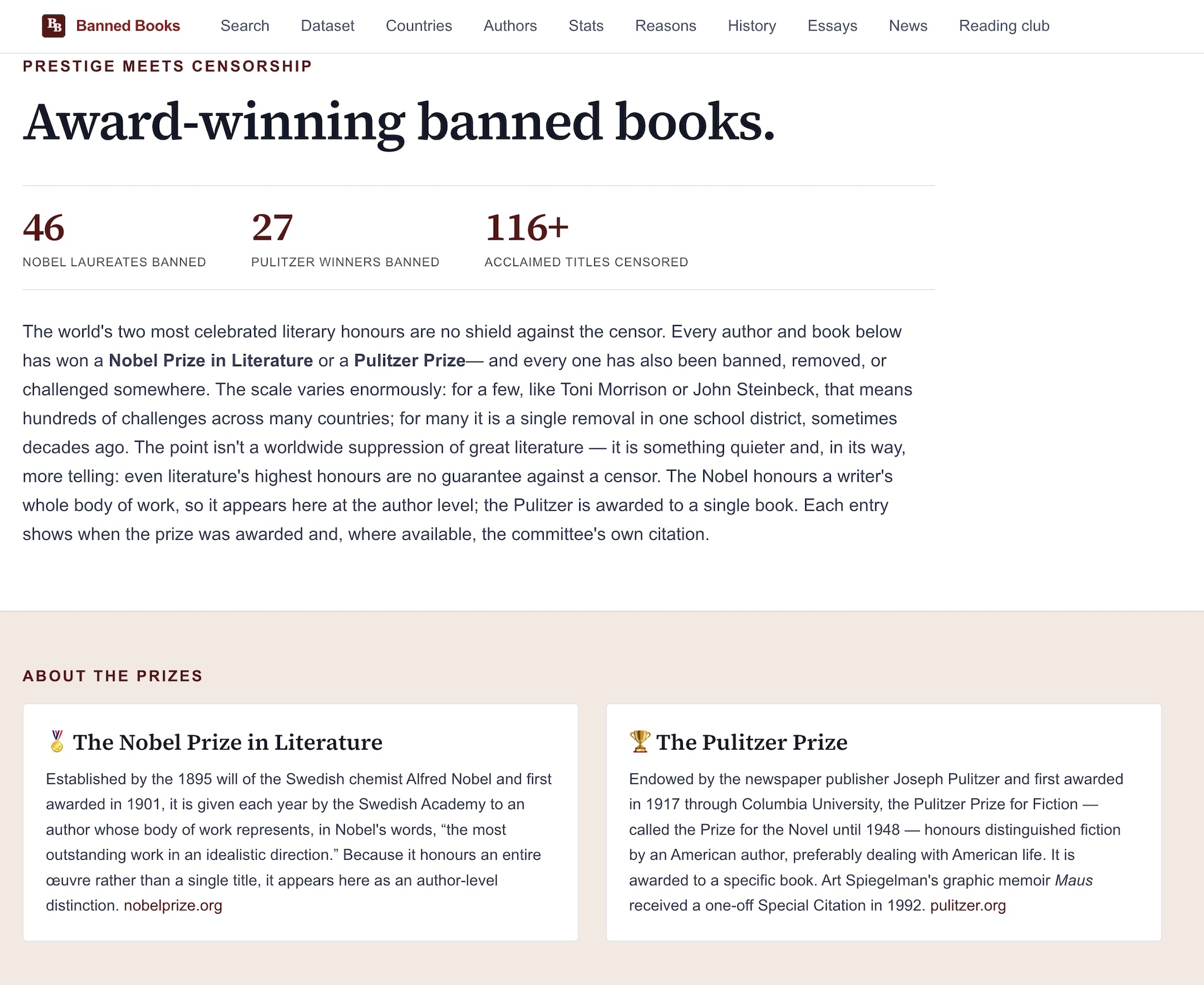
Award-winning banned books on Banned-Books.org
New open database documents banned books across 119 countries, from ancient Rome to 2026 — including 46 Nobel laureates and 27 Pulitzer winners.
GRONINGEN, NETHERLANDS, June 15, 2026 /EINPresswire.com/ -- Toni Morrison, John Steinbeck, Boris Pasternak, Gabriel García Márquez: writers honoured with the Nobel Prize in Literature whose books were later banned, removed, or challenged. A newly published open-data catalogue, banned-books.org, documents that pattern at scale — 46 Nobel laureates and 27 Pulitzer winners in its records have had work censored — as part of a wider effort to map book censorship across countries and historical periods.
The catalogue holds 15,887 distinct titles with at least one documented ban, restriction, or challenge, drawn from 119 countries — including states that no longer exist, such as the Soviet Union, East Germany, Czechoslovakia, and Yugoslavia. The earliest record dates to ancient Rome, where Ovid's Ars Amatoria was banished under Augustus; the most recent are from 2026. Every record traces back to a source citation, so readers can follow each claim to where it came from.
What distinguishes the project from the best-known reference points — the American Library Association and PEN America — is scope. Those organisations document censorship within the United States. banned-books.org records bans in 118 countries outside the US as well: nearly half of its 15,887 titles (7,905) appear in a country other than the United States, and at least 4,800 titles have an original language other than English. The aim is a single international reference rather than a patchwork of national lists.
A small number of titles recur across many jurisdictions. Salman Rushdie's The Satanic Verses appears in records from 22 countries; Lady Chatterley's Lover, 1984, and Animal Farm each across roughly a dozen. The overwhelming majority of banned titles, however, are recorded in just one country — in the data, censorship is mostly a local and national act, with a small core of works contested worldwide.
"The Nobel and Pulitzer numbers are not meant to suggest that only ‘great literature’ is at risk," said Ludo Raedts, who built the catalogue. "They show something more basic: status does not protect a book. Censorship is usually local, specific, and easy to overlook unless someone records who removed what, where, when, and why."
The catalogue's editorial approach is to document, not endorse. It records what happened — when and where a book was banned, and the cited reason — without taking a position on whether the ban was justified or whether the book has merit.
The open core of the dataset is available under a CC-BY-4.0 licence with a permanent citation identifier (DOI 10.5281/zenodo.20511553) for researchers, librarians, and educators; an enriched commercial version is also available. banned-books.org is an independent, one-person project based in the Netherlands, built with open-source tools and no funding from publishers, governments, or advocacy organisations.
Ludo Raedts
Banned-Books.org
+31 50 211 3474
email us here
Legal Disclaimer:
EIN Presswire provides this news content "as is" without warranty of any kind. We do not accept any responsibility or liability for the accuracy, content, images, videos, licenses, completeness, legality, or reliability of the information contained in this article. If you have any complaints or copyright issues related to this article, kindly contact the author above.
